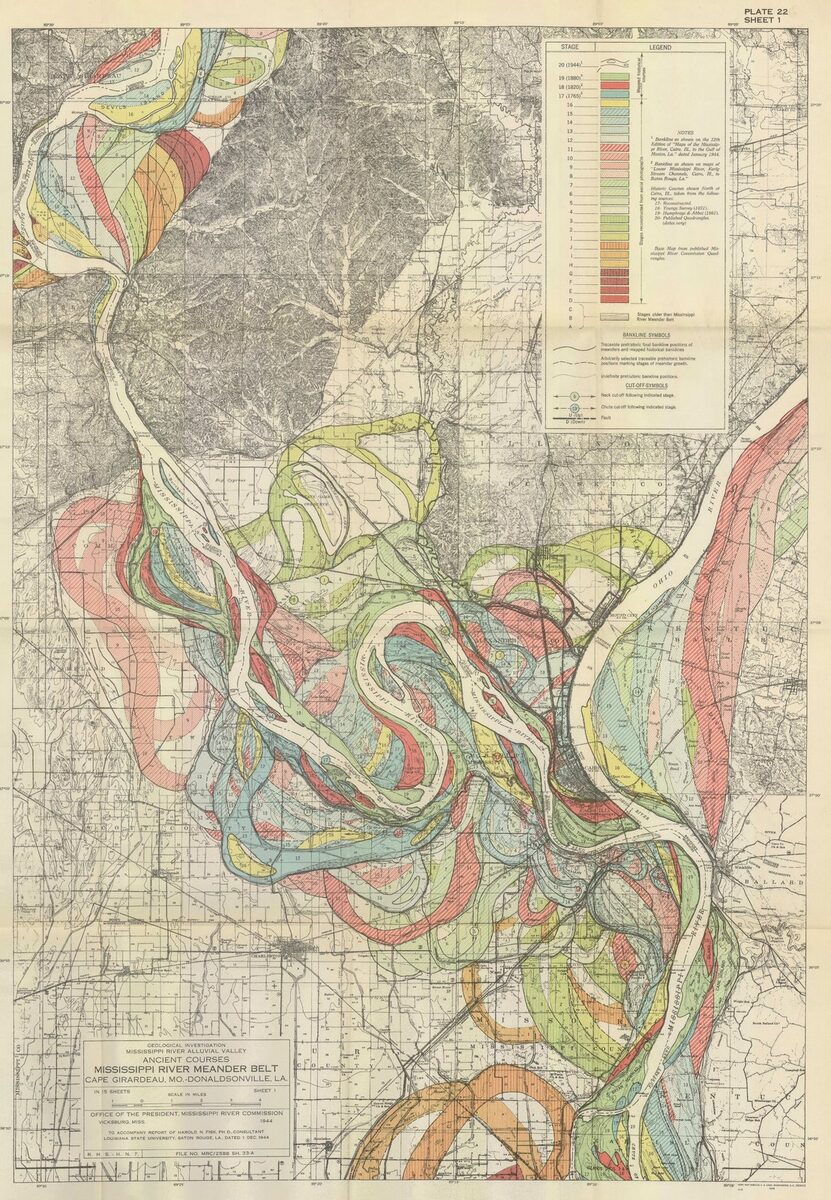
Plate 22 of Harold N. Fisk's Mississippi River Meander Belt, with historical channel courses overlaid in colored bands.
Plate 22 from Harold N. Fisk's 1944 Ancient Courses, Mississippi River Meander Belt (U.S. Army Corps of Engineers): one of fifteen colored maps tracing thousands of years of the river's channel migrations and historical flood paths across the alluvial valley. Public domain.

Module IV

Maps, Space, and Visualizing Place

What does a map ask you to believe? Every map is also a claim, about borders, names, what counts as a road, who lives where. Digital tools change the speed and scale at which those claims circulate; they don't make them more neutral. The spatial turn brought these questions into fields that had never thought of themselves as spatial. From counter-cartography to GPS dependency, we'll ask who benefits from the maps we already trust.

2 class sessions1 Digital Foray

Class 10 · April 1

Maps, Space and Visualizing Place I

3

Digital Foray · Before class, 12:30–2pm

Critical Mapping & Counter-Cartography

→

What is the “spatial turn” and what does it mean for your field? This session opens Module IV by examining how digital mapping tools render some places visible and leave others off the grid. From critical cartography to counter-mapping, we explore spatial history and the politics of place, asking what maps really do and whose stories they tell.

Class 11 · April 8

Maps, Space and Visualizing Place II

EventMidterm Presentations

Short midterm presentations followed by deeper engagement with spatial tools and theory. Find one or two maps in the news to present to the class. How does GPS dependence create new vulnerabilities? This session moves from theory to practice, examining how space is socially produced and how digital mapping can both reinforce and challenge dominant spatial narratives.